Definitions
Understanding Party Wall definitions
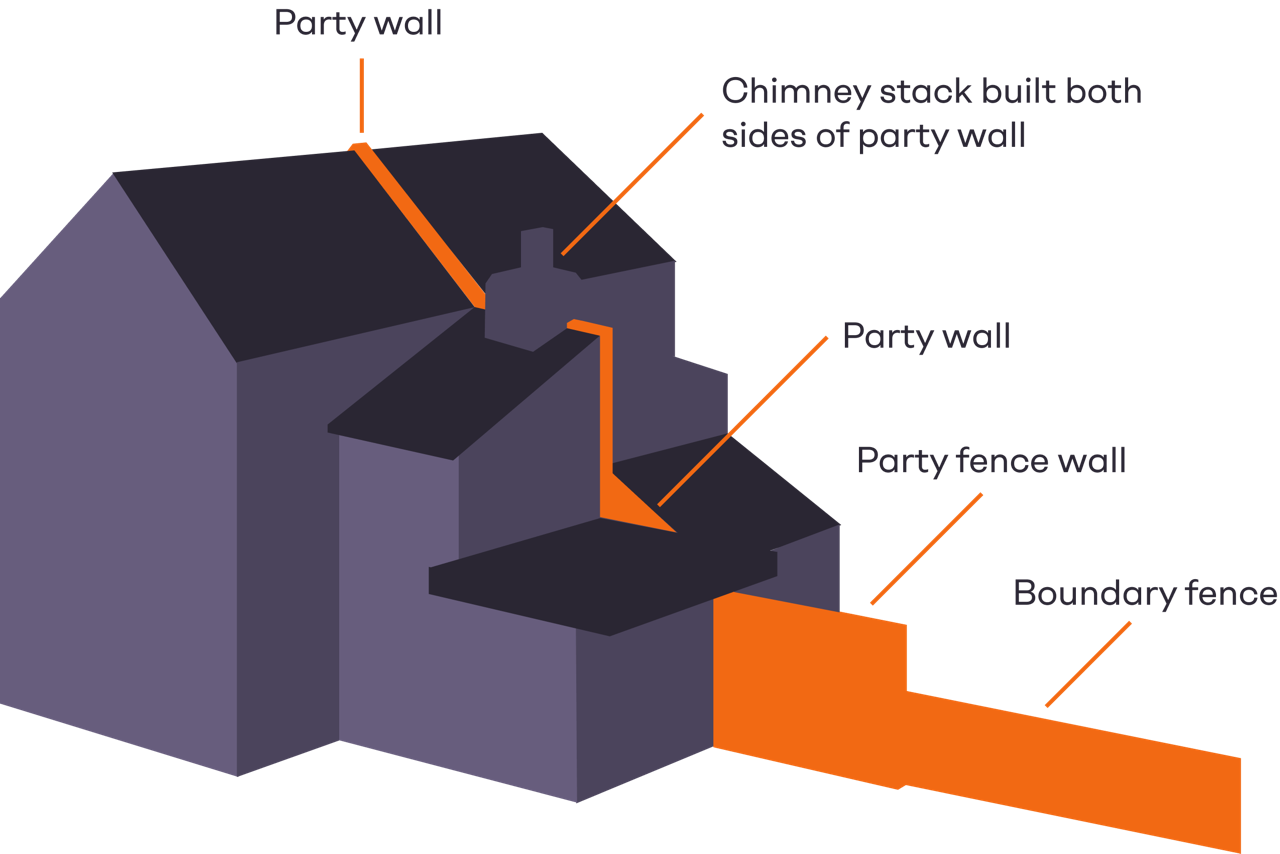
The Party Wall Act – Common terms:
Party Wall
A party wall (or floor) divides and separates buildings belonging to different owners. The wall might straddle the boundary line or be wholly within the boundary of one owner’s land but still functions as a dividing wall between buildings.
Party Fence Wall
A wall that is not part of a building but is on land belonging to several different owners eg a garden wall. Wooden fences are not considered a party fence wall.
Line of Junction
Similar to a boundary line that divides the lands of Adjoining Owners, the line of junction also extends upwards.
Building Owner
The owner who is proposing to carry out works falling within the scope of the Act.
Adjoining Owner
The owner of an adjoining property that may be affected by the proposed works
Party Wall Surveyor
The surveyor appointed by either or both owners. Their role is to ensure compliance with the Act. They remain impartial throughout the process and will resolve – to the satisfaction of all parties concerned – any disputes arising in connection to the works.
Building Owner Surveyor
The surveyor appointed by the Building Owner who is proposing the works.
Adjoining Owner Surveyor
The surveyor appointed by the owner of an adjoining property.
Agreed Surveyor
The surveyor appointed jointly by the Building Owner and Adjoining Owner.
Third Surveyor
The surveyor selected by the Building Owner Surveyor and Adjoining Owner Surveyor before works commence. The Third Surveyor will be involved only in the event that there is a matter that can’t be resolved by the Building Owner Surveyor.
Notices
Formal written notice by the Building Owner setting out the proposed works and served on the Adjoining Owner. The Building Owner must observe the minimum period of notice required.
Schedule of Condition
A formal written assessment and photographic record of the condition of the Adjoining Owner’s property before work commences. It’s important that this includes any existing defects or issues that could later be claimed as damage resulting from the works.
Award
A legal document, prepared by the surveyor(s), that sets out:
- Details of all parties involved
- The applicable sections of the Party Wall Act
- How the works will be carried out
- The rights and requirements of the Building Owner, Adjoining Owner and appointed surveyor
- Specific clauses relating to the works, such as the hours during which work can be carried out and rights of access
FAQs
General FAQ
This is a person appointed by the Building Owner or Adjoining Owner to resolve disputes relating to any proposed works covered by the Party Wall Act
Anyone may potentially act as a party wall surveyor except for the respective owners, who are not allowed to act for themselves. It is, however, beneficial to appoint a surveyor, architect or structural engineer who is experienced in the workings of the Act. The Faculty of Party Wall Surveyors has a members directory where you can find local experts.
Each party may appoint their own chosen surveyor or jointly appoint one surveyor. In the latter case that surveyor is known as the Agreed Surveyor.
The Building Owner’s surveyor draws up the Party Wall Award, which contains a description of the works to be undertaken and details the execution of the works. This includes the hours during which work can be carried out, what happens in the event of damage and rights of access. The Adjoining Owner’s surveyor checks the award for accuracy before agreeing it. The surveyors will also normally prepare and agree a schedule of condition.
The surveyor has a legal duty under the Party Wall etc Act 1996 to act impartially at all times. They are not considered to have been ‘employed’ by a Building Owner or Adjoining Owner, their role is to ensure compliance with the Act.
There are several categories of work that falls under the Party Wall Act – work on a party wall, building a wall on a boundary and excavations within a certain distance of your neighbour’s property. This can include:
- loft conversion
- extensions to a property
- internal works such as removing a chimney breast
- building a basement
- installing steel beams into a party wall
- structural works such as underpinning
The Building Owner’s surveyor draws up the Party Wall Award, which contains a description of the works to be undertaken and details the execution of the works. This includes the hours during which work can be carried out, what happens in the event of damage and rights of access. The Adjoining Owner’s surveyor checks the award for accuracy before agreeing it. The surveyors will also normally prepare and agree a schedule of condition.
Building Owners FAQ
A schedule of condition is a written record of the condition of the Adjoining Owner’s property before the work starts. It should record any existing defects or damage. It usually describes the walls, floors and ceilings and any other parts that may be affected by the works such as garden fencing or planting. Photographic evidence will usually support the schedule of condition.
Preparing a schedule of condition is not a requirement of the Act but it is advisable. If an Adjoining Owner does not grant access for this to be carried out then an Award may be made without one. However, if damage does then occur it may be more difficult to prove that the damage is attributable to the Building Owner’s works.
Your neighbour has 14 days in which to respond to a notice. If you don’t receive a response within that time frame or they do not consent to the work, you are deemed to be in dispute. At that stage, you and your neighbour will require the services of a party wall surveyor.
We recommend that you choose a surveyor who is a member of The Faculty of Party Wall Surveyors. This will ensure they have the necessary knowledge and expertise to resolve disputes and ensure works are carried out in accordance with the Party Wall Act. Importantly, once a surveyor has been appointed, the Act dictates that you cannot remove them in preference for someone else – making the right choice is therefore crucial.
You are legally obliged to give 1-2 months’ notice of any intended works, depending on the precise works.
Section 1 & Section 6 notices require 1 month’s notice
Section 3 notices require 2 months’ notice
It is important that the notices are served correctly because non-compliance may invalidate the process and cause delays to the proposed works. As the Building Owner you can issue a notice yourself. Beyond that, however, you will need to appoint a surveyor to deal with party wall matters on your behalf.
Adjoining Owners FAQ
The Building Owner carrying out the work is, in most cases, responsible for the cost of your surveyor. It’s important to understand this will be on the basis of ‘reasonable’ cost. For that reason, we recommend choosing a surveyor who is a member of The Faculty of Party Wall Surveyors.
The Party Wall Act gives certain rights to the Building Owner to enter the premises of the Adjoining Owner during working hours, on giving notice. However, access must be restricted to the purpose of undertaking the specified works and in compliance with the Act.
Your neighbour does not have the right to enter your land if they are building an extension – unless access to undertake the works can be shown to be absolutely necessary and in order to comply with the Act.
A surveyor is entitled to access either owner’s land in order to fulfil the purpose for which they have been appointed.
In the first instance you should speak to your neighbour, they may be unaware of the rules set out in the Party Wall etc. Act 1996. If work continues, this will be in violation of the law and, more importantly, you will not be protected under the Act. Consulting a Party Wall Surveyor at this stage will become essential. If your neighbour still fails to issue a notice, you may need to seek legal advice and obtain a court injunction to halt the works.
You are legally obliged to respond to the notice within 14 days. Whether you consent or dissent to the proposed works, the serving of that notice ensures that your interests are protected by the Party Wall Act. If you don’t respond or do not agree with the works, you will be in dispute and will require the services of a Party Wall Surveyor.
Boundary lines are not covered within the Party Wall Act. This is a legal issue that doesn’t involve a Party Wall Surveyor.